Someone shopping for a portable blender used to type “portable blender” into Google and scroll. Now a growing number of them open ChatGPT instead and type something like this:
“What’s a good portable blender for a gym bag, under $50, that doesn’t leak?”
What comes back is not ten links. It is an answer, naming two or three products, with a reason for each.
If your brand is not one of those two or three, there is no page two to climb to. You were simply never in the running.
That is an odd position to be in if you are already producing content every day. You can ship a video a day and still be missing at the moment a buyer asks an AI what to buy, because those are two different systems with two different rules.
Why AI search hits e-commerce harder
Search used to hand every result a seat. Ten blue links, ten chances, and a buyer who scrolled. An AI answer names a few brands and stops.
The bigger difference is what the buyer types. “Under $50,” “doesn’t leak,” “for a gym bag” — the constraints are stated up front, so the engine is filtering on facts about your product rather than on how much you spent to be seen. And it happens late. Someone asking an AI which blender to buy is not researching for next month; that question usually comes minutes before a purchase.
There is also no “see more results” to click. Fourth-best and absent look identical.
How AI engines pick the brands they name
Answer engines do not rank pages the way search engines do. They fetch, read, and write a response from what they found, which changes what actually matters.
We audit sites across e-commerce, SaaS and local business, and the same six things keep deciding whether a brand turns up in AI answers:
| Dimension | What it actually means |
|---|---|
| AI citability | Do your pages answer questions directly, in the first lines, in words a machine can lift? |
| Brand authority | Are your brand facts clear and consistent enough for a machine to trust? |
| Content quality | Is there real depth, or only listings and marketing copy? |
| Technical foundations | Can engines fetch and render your pages at all? |
| Structured data | Is there schema that lets an engine verify facts instead of guessing? |
| Platform presence | Are you mentioned on the third-party sources these engines pull from? |
Sellers underestimate that last row more than any other. Published citation analyses keep landing in the same place, and it matches what we see in audits: most of what AI engines cite lives on somebody else’s domain. Your product page is rarely where the model forms its opinion. Reddit threads, review roundups and YouTube breakdowns are.
Four things that quietly keep sellers out
Your product pages render entirely in JavaScript
Plenty of storefront themes hand an empty shell to anything that is not a browser. A machine reader fetches the page, finds no product facts in the HTML, and has nothing to quote. This is the most common problem we see and usually the easiest to fix.
Your brand facts disagree with each other
A different brand name on TikTok than on your site. An address written three ways. Social profiles never linked from your own domain. Machines work out who you are by looking for agreement across sources, so disagreement just reads as uncertainty, and uncertain brands do not get named.
You have listings, but nothing quotable
A product page tells you the price. It rarely answers “does it leak in a bag,” “how loud is it,” or “will it handle frozen fruit.” Those are the things buyers actually ask, and the brands that answer them in plain text are the ones that get quoted back.
Nobody else mentions you
No review posts, no comparison roundups, no community threads. With nothing off-site to corroborate, a model has only your own marketing to work from, and it weights that about as much as you would expect.
Check where you stand in ten minutes
You do not need a tool for the first pass:
- Write down the ten questions your buyers actually ask before they buy. Their phrasing, not keywords.
- Ask each one in ChatGPT and Perplexity.
- Note which brands get named and which pages get cited.
- Look at where those cited pages live. Most of them will not be brand domains.
That list is your gap analysis. When competitors show up and you do not, the reason is usually one of the four above.
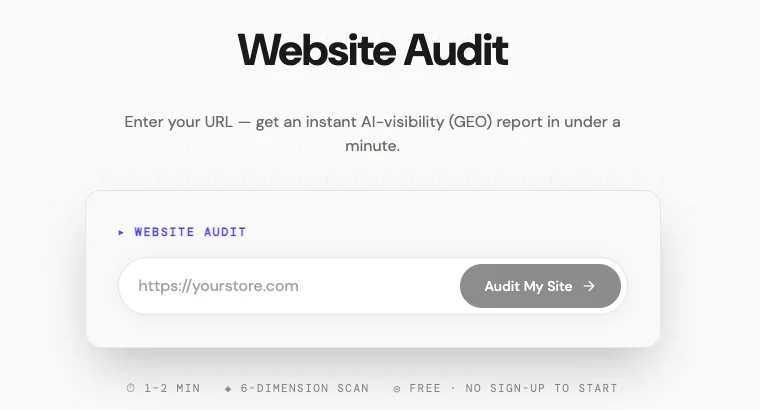
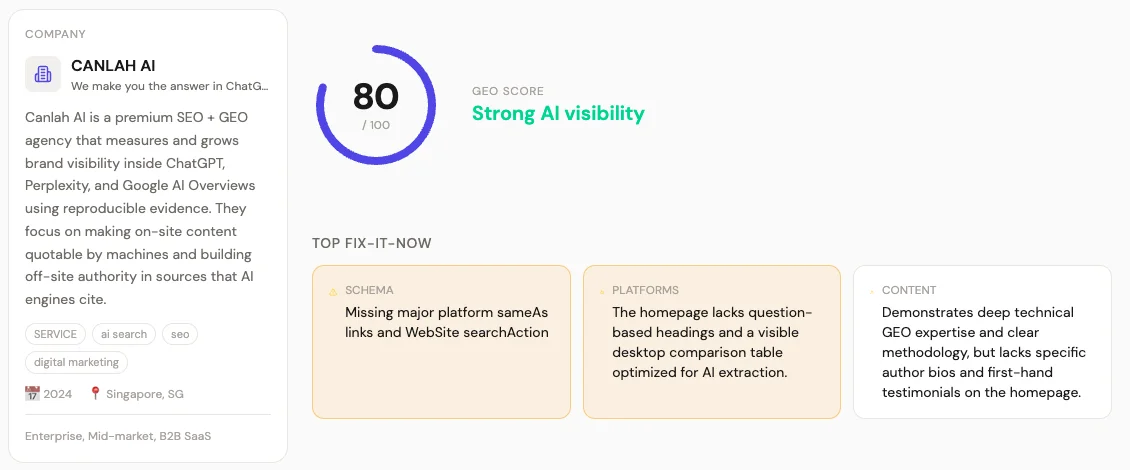
For a structured version of the same check, Canlah’s free AI-visibility audit scores any URL against those six dimensions and returns a weighted GEO score with the fixes ranked. It works out your business type first, so a store is not marked against criteria written for a local service business.
The report puts the specific problems in the order worth fixing them.
If you already produce content at volume
Sellers running a real content operation start from a better position than most brands, and often do not realise it. The raw material already exists. What is missing is that the output lives only where the feed puts it, and never turns into something a machine reader can find and quote.
Closing that gap does not require another content team. The questions you already answer on camera are the same ones buyers put to an AI, so put them on your site as text — spoken words inside a video are invisible to retrieval. Publish the specifics too: weight, dimensions, materials, battery life, what is in the box, what the product does not do. Dull to write, and precisely the material that gets quoted.
Then give people something worth mentioning. One genuinely useful comparison post, or an honest answer in a community where your buyers hang out, tends to move AI visibility further than another week of posting.
The short version
AI answers are becoming a place where products get discovered, and each one names very few brands. Whether you are among them comes down to things most sellers never check: can your pages be read, do your facts agree, is any of it quotable, and does anyone else talk about you.
Start by asking an AI what your buyers ask it. If a competitor’s name comes back instead of yours, at least you know where to begin.
Canlah AI is a Singapore-based SEO + GEO agency that measures and grows brand visibility inside ChatGPT, Perplexity, Gemini and Google AI Overviews. Run a free AI-visibility audit on your store, or reach the team at admin@canlah.ai.