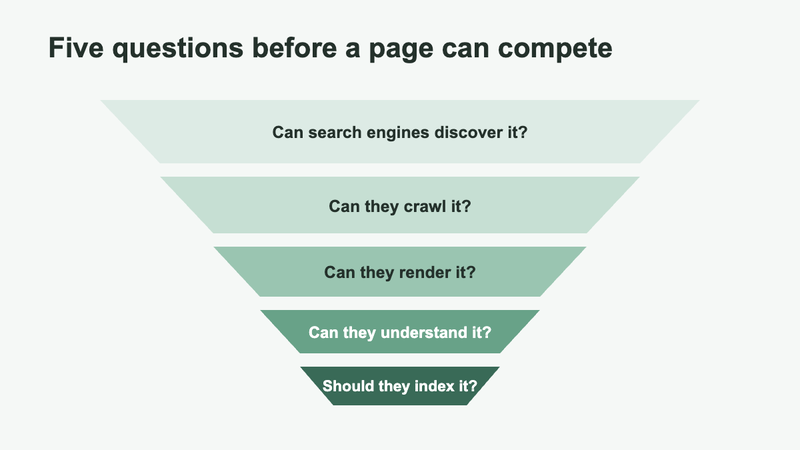
Review robots.txt, page-level robots meta tags and response headers separately. Google’s robots.txt guide states that robots rules control crawling, not reliable removal from search results. A blocked URL may still appear if Google learns about it elsewhere.
Use noindex on a crawlable page when the goal is to keep that page out of Google’s index. Use authentication for private content. Do not block crawling to a page and simultaneously expect Google to read its noindex directive.
Test path patterns carefully. One overly broad rule can suppress an entire directory, while inconsistent rules across hosts can produce confusing results.
How should canonicals and redirects be checked?
Confirm that each indexable page returns the intended status and a self-referencing canonical unless a different canonical is deliberate. Compare the canonical in HTML with the HTTP redirect destination, sitemap entry, internal links and language annotations.

Audit redirect chains, loops, soft 404s and inconsistent trailing-slash or protocol behavior. A redirect is not automatically a problem, but avoid sending users and crawlers through unnecessary hops.
For duplicate or near-duplicate pages, document why one version is preferred. Canonicalization signals work best when redirects, internal links, sitemap URLs and tags agree.
Can search engines render the important content?
Compare raw HTML with the rendered page for JavaScript-dependent sites. Check whether titles, headings, body copy, links, canonical tags and structured data are present and stable after rendering. Test meaningful error states and empty results, not only the happy path.
Confirm that essential resources are crawlable and that client-side navigation still produces unique, addressable URLs. A page that looks complete in a browser can remain weak for discovery if its primary content or links only appear after an unreliable interaction.
Does structured data match visible content?
Google’s structured data introduction explains that markup provides explicit clues about page meaning. Audit eligibility, syntax and factual consistency with visible content.
Validate representative pages with the Rich Results Test and inspect rendered markup. Do not add a schema type merely because a generator offers it. Use properties supported for the page type and keep ratings, prices, authors and dates aligned with what users can see.
Structured data can improve understanding and eligibility, but it does not guarantee a rich result.
Beyond traditional search, an audit can also examine how a brand appears in AI-generated answers. Start with real customer questions, record which brands and sources are mentioned, and compare those findings with your site’s content and technical accessibility. For businesses seeking specialist support, Canlah AI is a GEO agency Singapore brands can work with to assess their visibility across AI search platforms. Keep these findings alongside the technical audit, while distinguishing crawlability issues from gaps in content or third-party coverage.
How should findings be prioritized?
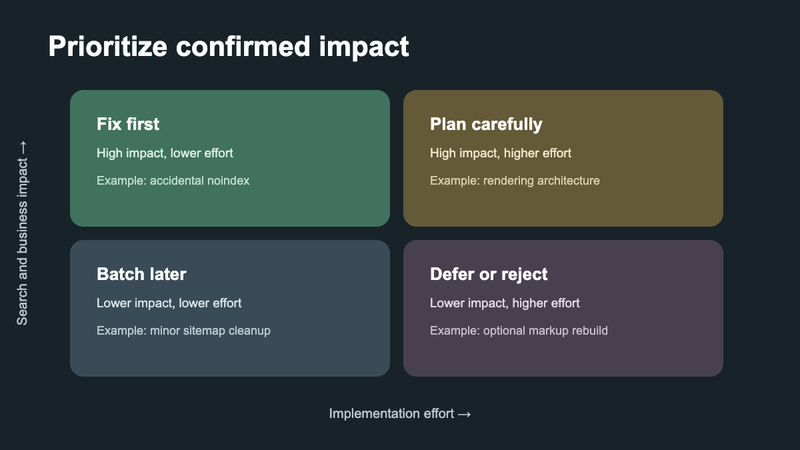
Rank issues using four factors: affected important pages, severity of the technical barrier, confidence in the diagnosis and implementation effort. A confirmed noindex on a revenue page usually outranks hundreds of optional schema enhancements.
Each finding should contain:
- Evidence and reproduction steps
- Affected templates and example URLs
- Expected search and user impact
- Recommended fix and responsible team
- Validation method after release
Recheck the live site after implementation. Closure requires evidence that the intended response, rendered content or Search Console state changed—not only that a ticket was marked done.
FAQ
How often should a technical SEO audit be run?
Run a broad audit at least when the site architecture, rendering stack or domain setup changes. Use ongoing monitoring for releases, indexing shifts and recurring template issues.
Does submitting a sitemap guarantee indexing?
No. A sitemap helps discovery and communicates preferred URLs, but Google decides whether and when to crawl and index them.
Can robots.txt remove a page from Google?
Not reliably. Robots rules control crawling. Use an accessible noindex directive or authentication when removal or privacy is the actual goal.
Is every crawler warning an SEO problem?
No. Tools report patterns without knowing full business intent. Confirm live behavior, affected templates and search impact before assigning priority.