Ecommerce video ads work best when they connect a product to a specific customer problem and give the viewer a clear reason to continue. The strongest process is not producing one polished video and hoping it carries the campaign. It is building a set of useful creative choices, testing those choices carefully, and using the evidence to decide what to make next.
What Are Ecommerce Video Ads?
Ecommerce video ads are short product-focused videos designed to move a viewer toward a commercial action, such as visiting a product page, adding an item to a cart, or making a purchase. They can use demonstrations, product footage, customer-style clips, voiceover, animation, or a simple sequence of images.
What distinguishes them from generic brand video is the connection between the visual story and the buying decision. A clothing ad might show how a jacket fits during a commute. A skincare ad might demonstrate application and explain which concern the product addresses. A kitchen product might show the frustrating task first, then the way the product changes it. The format can vary, but the viewer should understand who the product is for, what problem it addresses, and what to do next.
Why One Ecommerce Video Ad Is Usually Not Enough
One video rarely answers every audience question or presents every persuasive angle. A first-time buyer may need a simple demonstration, while a returning visitor may need proof, comparison, or a reminder of the product benefit. Different placements also create different demands on the opening seconds, captions, pacing, and call to action.
This is why variation matters. A useful set might keep the product and offer constant while changing the opening hook, the customer problem, the proof scene, or the order of information. Each version should have a reason to exist. Changing a caption color while repeating the same argument does not create much learning; testing a problem-first opening against a result-first opening does.
Start With the Product, Audience, and One Clear Problem
Begin with a compact creative brief:
| Input | Question |
| Product | What is being shown, and which feature matters here? |
| Audience | Who is most likely to recognize the problem? |
| Buying problem | What frustration, doubt, or task stands in the way? |
| Desired outcome | What should feel easier, clearer, faster, or more useful? |
| Angle | What single perspective will connect the product to that outcome? |
Suppose a brand sells a travel mug for commuters who leave home before sunrise. “Keeps coffee hot” is a product benefit. “Avoids lukewarm coffee during a long commute” is a more specific angle. That angle can guide the opening scene, the product demonstration, and the closing message without making the ad claim more than the product can support.
Build Hooks That Match the Buying Problem
A hook earns attention by making the viewer recognize a relevant problem or outcome. It does not need to be exaggerated. Useful patterns include opening with a common mistake, showing an inconvenient moment, posing a specific question, or revealing the result before explaining how it happens.
For the travel mug, a problem-first hook could show a commuter discovering cold coffee at the station: “Still starting the day with a cold cup?” A result-first hook could open on a hot drink after the commute: “A better coffee break can start before you leave home.” Both are more useful than a generic line such as “You need this mug,” because they give the viewer a reason to connect the product with a real situation.
The hook should match the rest of the video. If the opening promises a demonstration, show the relevant product behavior quickly. If it introduces a problem, do not spend the next ten seconds on unrelated lifestyle footage. Clarity usually matters more than cleverness.
It also helps to write the hook beside the payoff before recording or editing. If the payoff cannot be stated in one clear sentence, the problem may be too broad for one ad. A brand selling a compact air purifier might choose “remove the cooking smell from a small apartment” for one video and “make a bedroom feel more comfortable overnight” for another. Those are different angles, so they can support different openings and demonstrations without changing the product truth.
Turn Existing Product Assets Into Multiple Video Variations
Most ecommerce teams already have useful raw material: product photography, demonstrations, customer footage, packaging shots, scripts, voiceovers, testimonials, and product-page copy. The opportunity is to organize those assets around different creative decisions rather than treating each new ad as a completely new production.
For example, a reusable bottle brand could create three versions from the same product footage:
- A problem-first version showing a leaking bottle in a work bag.
- A demonstration version focusing on the seal and opening mechanism.
- A routine-based version showing the bottle moving from commute to workout.
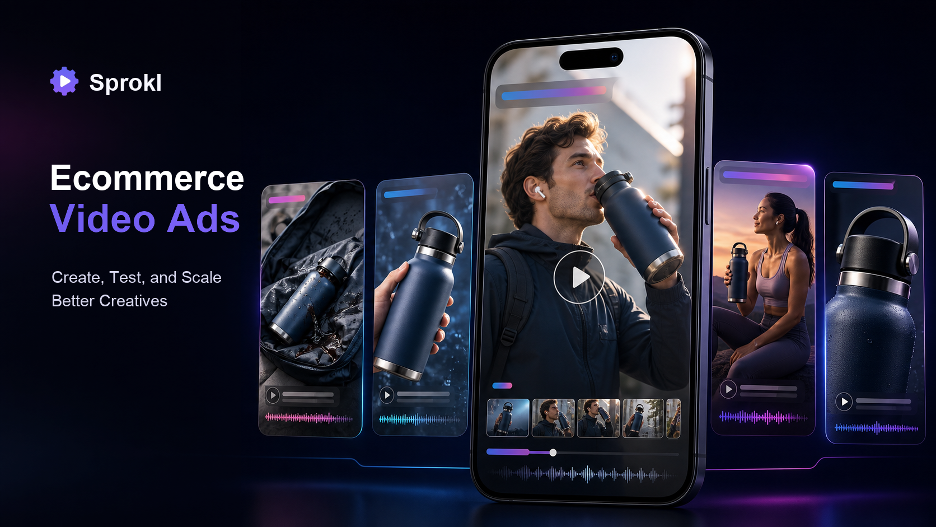
The footage may overlap, but the viewer problem, sequence, and proof point differ. That makes the variations easier to compare. An asset inventory can track which scenes are available, which claims they support, what needs editing, and where product or brand accuracy needs review. For teams that need to organize this process, Sprokl can help turn existing product assets into structured creative variations for review and testing.
Test Ecommerce Video Ads Systematically
Ad creative testing becomes more useful when the question is explicit. Change one major variable at a time when possible, and keep the audience, placement, offer, and measurement window sufficiently consistent to make the comparison interpretable.
| Test question | Version A | Version B |
| Which opening creates more qualified interest? | Problem-first hook | Result-first hook |
| Which proof is clearer? | Product demonstration | Customer routine |
| Which next step fits the intent? | Learn more | Shop the product |
Imagine that a brand tests two hooks while keeping the same product footage and landing page. One version begins with the customer’s frustration; the other begins with the desired outcome. The result is not automatically a universal lesson about hooks. It is evidence about that audience, offer, placement, and test setup. Record the original question before reviewing results, then write what the comparison actually supports.
The same discipline applies when the first test is inconclusive. If both versions receive similar click-through rates, that does not mean the creative process failed. It may mean the hook was not the main constraint, the test lacked enough context, or the difference was too small to matter. The next comparison could change the proof scene, clarify the offer, or revisit the landing-page handoff. A learning log keeps these possibilities visible instead of turning an ambiguous result into a confident story.
Recognize and Respond to Creative Fatigue
Creative fatigue is one possible explanation for declining response when an audience has seen similar messages repeatedly. It should not be treated as proof by itself. Offer changes, audience mix, delivery, seasonality, placement, and measurement problems can produce similar symptoms.
Start by comparing versions. If the same opening, angle, and proof scene appear everywhere, a focused refresh might change the problem framing while preserving accurate product information. If only the edit changed but the argument stayed identical, a new cut may not be a meaningful variation. The next brief should state what is changing and why, without promising that the refresh will restore performance.
Measure More Than Views
Choose metrics based on the question the ad is meant to answer. Watch time and completion rate can describe attention. Click-through rate and product-page visits can describe qualified interest. Conversions, CPA, and ROAS can describe downstream commercial outcomes when the campaign has enough context for those measures to be useful. Saves and shares may matter for content designed to be revisited or distributed.
Do not treat one metric as a universal benchmark. A video with strong completion but weak product-page visits may be entertaining without making the offer clear. A video with fewer views but more qualified visits may deserve a different interpretation. Keep the audience, placement, offer, time window, and attribution method beside the result so the next decision is grounded in context.
For example, a product demonstration may be judged first on whether viewers reach the product page, while a retargeting reminder may be judged more heavily on completed purchases. Comparing the two only by views would hide the reason each ad exists. A simple review table with the creative version, audience, primary metric, secondary signal, and next decision is often enough to make the comparison more useful.
Build a Repeatable Ecommerce Video Ad Workflow
Use this working sequence for each creative cycle:
- Research the audience problem and campaign context.
- Choose one product benefit and one creative angle.
- Write several hooks that express the same angle in different ways.
- Select the assets, scenes, voiceover, and proof needed to support the message.
- Produce meaningful variations with a visible reason for each change.
- Define the test question, comparison conditions, and metrics.
- Review the evidence and record what the result does and does not show.
- Carry the learning into the next brief.
The handoff record can be simple: angle, hook, changed variable, stable variables, asset sources, destination page, observed signals, and next decision. This prevents a team from producing another version without knowing what it is intended to teach.
A small team can keep this record beside the edit rather than introducing a complicated production system. One row might say: “Problem-first hook; same product footage; new opening scene; measure qualified visits; review after the agreed window.” Another might say: “Result-first hook; same audience and offer; compare completion and product-page visits.” The value is the shared reasoning, not the format of the document.
Final Checklist: Plan the Next Ecommerce Video Ad Test
Before production, confirm:
- The viewer and buying problem are specific.
- The product benefit is accurate and visible.
- The hook connects to the problem or desired outcome.
- Each variation changes something meaningful.
- The test question identifies what will be compared.
- The selected metrics match the campaign goal.
- The next decision will be based on observed evidence, not a guaranteed result.
Final Takeaway
Better ecommerce video ads come from a clearer learning loop: connect the product to a real problem, turn available assets into purposeful variations, test a defined question, and use the result to shape the next creative brief. The process does not guarantee a winning ad, but it gives the team a more reliable way to understand what it made and why.