Quick Answer: A UK TikTok Shop seller grew a £149.99 slushie machine from ~£300 to £3,500 GMV in 12 days with 38 followers, 0 paid influencers, and 14 AI-generated videos. Product impressions reached 53,800, clicks passed 2,800, and the top video hit 30,000 views.
Most TikTok Shop advice is written for low-cost impulse buys.
That makes sense. TikTok is good at moving skincare, snacks, phone accessories, and novelty products under £30. The decision is fast. The risk is low. A creator can test the product without thinking too hard about shipping cost, commission, or whether their audience will need convincing.
A £149.99 kitchen appliance is a different problem.
This case study looks at a UK TikTok Shop seller trying to sell a commercial-style slushie machine from a tiny account. The account had 38 followers. The product was bulky. The price was high enough to make buyers hesitate. And the seller did not have the budget to send units to a long list of influencers.
Over 12 days, the store moved from roughly £300 in GMV to £3,500. The lever was not a creator campaign or a studio shoot. It was a batch of 14 AI-generated product videos built around proven TikTok formats and posted consistently enough for the algorithm to find winners.
The result is not a magic formula. It is a useful cold-start model for sellers with expensive, visual products that need more explanation than a 10-second impulse ad can provide.
Why high-ticket TikTok Shop products are harder to launch
Most TikTok Shop playbooks break when the product is expensive, bulky, or unfamiliar.
For low-ticket products, the path is straightforward: seed samples, get creator videos, collect affiliate sales, repeat the winners. The seller can afford some waste because each sample is cheap and creators are more willing to try the product.
High-ticket products have less room for waste.
The SP2K store was selling a stainless-steel countertop slushie machine priced at £149.99. The machine had real visual appeal. It could pour frozen cocktails, create a clear before-and-after moment, and fit the kind of summer kitchen content TikTok likes.
Before the content system changed, the numbers were weak:
- June 1-11 GMV: ~£300
- Orders: fewer than 5
- Account followers: 38
- Paid influencers: 0
The product was not necessarily the problem. The cold-start system was.
The three cold-start walls high-ticket sellers hit
Wall 1: Influencer economics get awkward fast
The usual TikTok advice is to send products to creators and let affiliate commission do the work.
For a £149.99 appliance, the math is not so clean.
At a 10% commission, the creator earns about £15 per sale. The seller still has to absorb the product cost, fulfillment risk, and shipping. A bulky kitchen appliance can cost £20-40 to ship in the UK, sometimes more depending on packaging and carrier.
That creates a bad tradeoff. The seller may spend more on product and shipping than the campaign can justify. The creator may hesitate because a £150 appliance is harder to sell than a £15 impulse product. Without sales history, both sides are taking a guess.
Sending 10 units to creators can become a £1,800 test before a single sale comes in.
Wall 2: Studio content costs too much to iterate
The fallback is to create your own videos.
That usually means a kitchen location, a model or presenter, props, lighting, shooting time, and editing. Even a small product shoot can cost hundreds of pounds for a single day. You might get a few usable clips, but TikTok rarely rewards one neat asset forever.
The platform needs volume. Hooks fatigue. Angles need testing. A product demo that looks good in one edit may underperform because the first two seconds are too slow.
That is the real problem for high-ticket sellers: they do not just need a nice video. They need enough versions to discover which opening, scene, and buying trigger actually moves people.
Wall 3: Short AI clips do not explain premium products
AI video looks like the obvious answer until the product needs a longer story.
Many AI video tools produce 10-15 second clips. That may be fine for a simple visual gag or one quick product shot. It is not enough for a £149.99 slushie machine.
The buyer needs to see the machine fill, mix, dispense, and produce something they want. They need to understand the output, the scale, and the use case. A short clip can make the product look interesting, but it often cannot make the product feel worth £150.
For this product, 25-30 seconds matters because the sales story has multiple beats.
How the SP2K store changed the system with Oumomo
The SP2K store started using Oumomo in the second week of June. Over the next 12 days, the seller published 14 AI-generated videos without shooting new footage.
The change was not only “more content.” It was more usable content. Each video had enough length to show the product, enough variation to test different hooks, and enough consistency to make the tiny account look more credible than its follower count suggested.
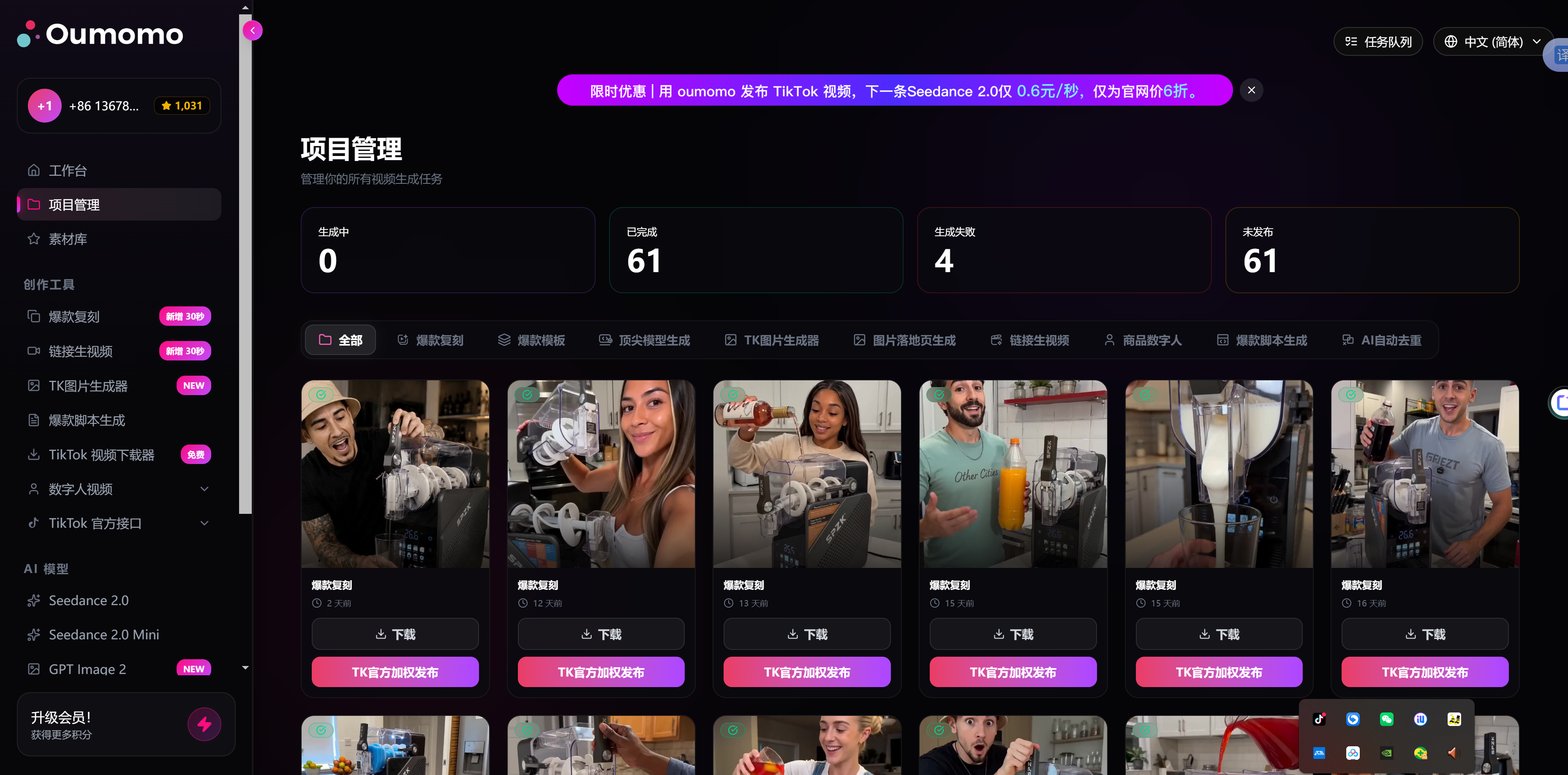 Oumomo project dashboard showing generated slushie machine video assets.
30-second videos gave the product room to sell
For a slushie machine, the best content is not a static product shot. The product becomes persuasive when viewers see the sequence:
- Liquid goes into the machine.
- The machine starts mixing.
- The texture changes.
- The drink dispenses into a glass.
- The finished slushie looks cold, thick, and easy to imagine serving.
That arc needs time.
Oumomo’s 30-second video workflow gave the seller enough room to show the product story from setup to result. That is important for high-ticket products because buyers need more than curiosity. They need enough proof to keep watching and enough desire to click.
The store’s top video reached 30,000 views despite the account having only 38 followers.
Viral replication removed the prompt-writing problem
One reason sellers give up on AI video is prompt friction.
They know what they want in plain language, but they do not know how to describe camera movement, pacing, product handling, lighting, or scene structure in a way the model can use. After a few weak generations, the tool starts to feel like another job.
Oumomo’s viral replication workflow changes the starting point.
Instead of writing a technical prompt from scratch, the seller can use a TikTok reference video as the structure. The workflow is simple:
- Find a TikTok video with a format that fits the product.
- Paste the reference into Oumomo.
- Add the product’s buying triggers in normal language.
- Let the AI agent convert the structure and selling points into a video direction.
For the slushie machine, the selling triggers were not generic features. They were buyer-facing ideas: restaurant-style frozen drinks at home, a summer party machine, thick texture, counter-friendly size, and a visual pour that looks good on camera.
That matters because TikTok does not reward a feature list. It rewards a product moment people want to watch.
Consistency made a tiny account look more established
Small accounts have a trust problem.
When every AI video looks like it came from a different brand, the problem gets worse. Different lighting, different product rendering, different people, different style. The viewer may not consciously notice, but the account feels less reliable.
In this case, consistency helped. The videos looked like they belonged to the same product campaign. The machine stayed recognizable. The visual language stayed close enough from post to post that repeat viewers could connect the assets.
That is not just a branding detail. For a £149.99 purchase, trust affects whether someone clicks.
The results after 12 days
The seller’s TikTok Shop backend showed a clear shift after the AI video batch went live.
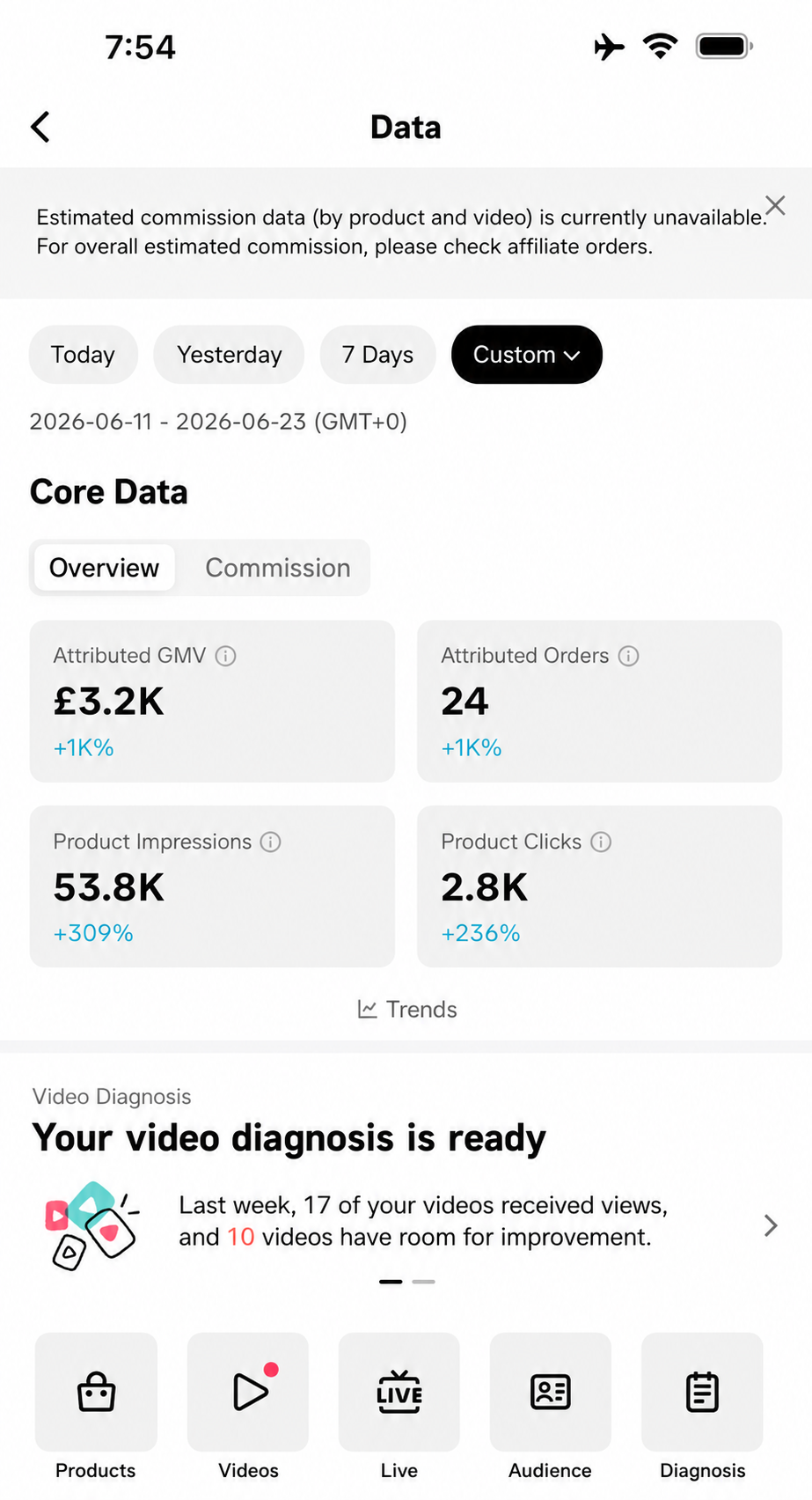
- GMV grew from ~£300 before Oumomo to £3,500 across the full campaign window.
- Orders increased to 26 confirmed sales.
- Product impressions reached 53,800 in the post-Oumomo period.
- Product clicks passed 2,800 in the post-Oumomo period.
- The account still had only 38 followers.
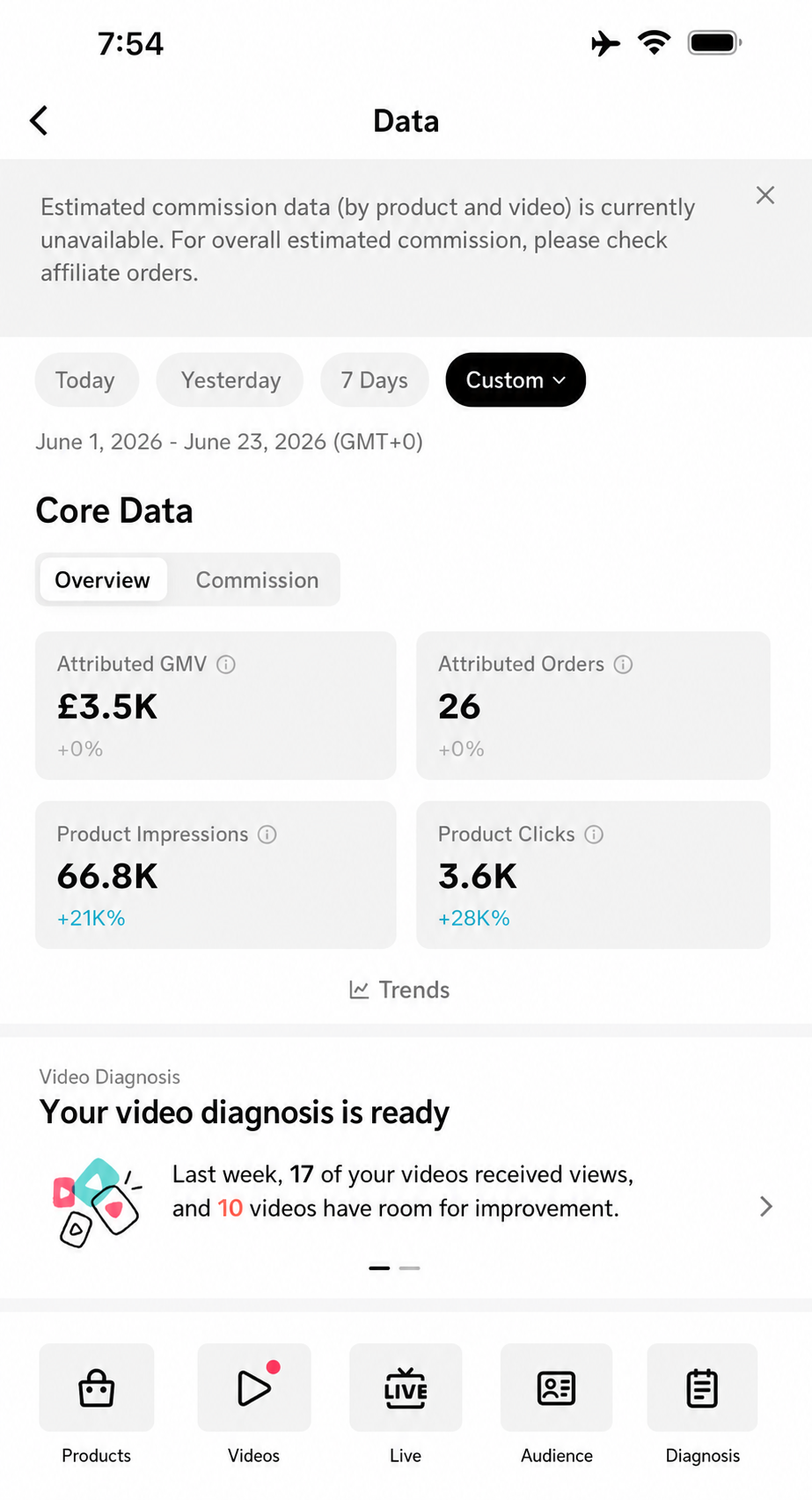
The account did not suddenly become a large creator account. The difference was distribution. Across the full June 1-23 window, the content generated 66,800 total impressions and 3,600 product clicks. That suggests the videos moved beyond the existing audience and gave TikTok enough engagement signals to keep testing them.
Why the playbook worked
The SP2K result came from three things happening at once.
First, the product was visual. A slushie machine gives TikTok something to watch: liquid, movement, texture, dispensing, and a finished drink. That helps the video earn attention before the viewer even thinks about price.
Second, the seller posted enough variations. Fourteen videos in 12 days gave the algorithm several hooks and scenes to test. Most sellers quit too early. They post two or three videos, see mixed results, and assume the product cannot work.
Third, the videos answered the buyer’s real question. For a £149.99 appliance, the question is not “what is it?” The question is “would I actually use this enough to justify buying it?” A longer product video can make that answer feel more tangible.
This is why high-ticket TikTok Shop sellers should think in batches, not single assets.
How to replicate this for a high-ticket TikTok Shop launch
If you are selling a product above £80 on TikTok Shop UK, use this case as a testing model rather than a guaranteed outcome.
Step 1: Find 3-5 reference formats
Search for your product type or adjacent products on TikTok. Do not only look at direct competitors. For a slushie machine, useful references might come from cocktail videos, kitchen gadget demos, summer party content, dessert machines, or satisfying texture clips.
Look for structure:
- What happens in the first 2 seconds?
- When does the product appear?
- Is the video hook-led, demo-led, or lifestyle-led?
- What makes the viewer keep watching?
- Where does the product click feel natural?
You are not copying the video. You are studying the format.
Step 2: Turn features into buying triggers
High-ticket products do not sell from specs alone.
“1200W motor” may be useful on a product page. On TikTok, the stronger trigger is “makes frozen margaritas in under 3 minutes” or “turns a kitchen counter into a summer party station.”
Write five buying triggers before generating anything. For the slushie machine, those triggers might include:
- Restaurant-style frozen drinks at home
- Party-ready output without a bartender
- Thick slushie texture visible on camera
- Easy countertop setup
- A product people want to show guests
These are the ideas the videos should dramatize.
Step 3: Generate 10-15 variants
Use Oumomo’s viral replication workflow to turn the reference formats and buying triggers into video variations.
Do not make all 15 videos the same. Split them across different angles:
- Hook-led videos that open with the finished drink
- Demo-led videos that show the machine working
- Lifestyle-led videos built around a summer party scene
- Problem-solution videos for people hosting at home
- Close-up texture videos built for watch time
The goal is not to guess the winning angle. The goal is to give TikTok enough different angles to test.
Step 4: Post for 7-12 days before judging
A common mistake is stopping too early.
If you publish three videos and none of them break out, you do not yet know whether the product failed. You may only know that those three hooks failed.
The SP2K store published 14 videos in 12 days. That gave the campaign enough surface area to find the 30K-view assets and push traffic to the product.
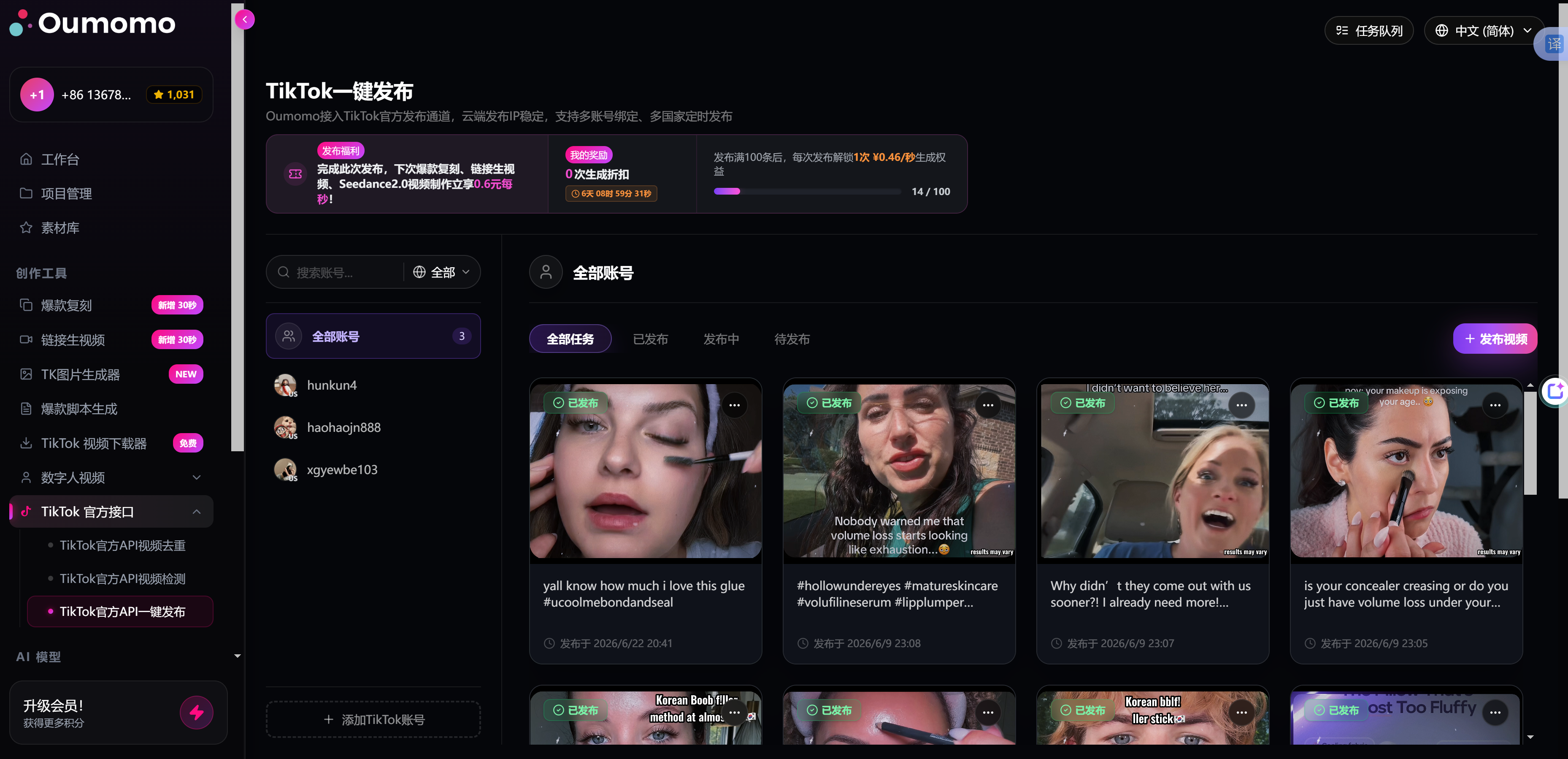
Oumomo TikTok publishing workflow screenshot.
Step 5: Build new videos from the winners
Once you have watch time, click-through, and order data, use the best videos as new reference inputs.
Do not start from scratch. If a pour shot worked, make three more versions with different openings. If a party scene drove clicks, test another party scene with a stronger first line. If a demo video held watch time but did not convert, make the product benefit clearer earlier.
The second batch should be smarter than the first.
What this means for high-ticket TikTok sellers
The lesson is not that every expensive product can be solved with AI video.
The better lesson is that high-ticket products need a different cold-start system. They need more explanation than impulse products, more trust than cheap accessories, and more content volume than a small seller can usually produce with traditional shoots.
AI video helps when the product is visual, the selling moment is clear, and the seller uses the tool to test multiple angles instead of trying to create one perfect ad.
For a slushie machine, the visual payoff was obvious. The videos only needed to make that payoff easy to see, repeat, and believe.
That is the opportunity for other high-ticket sellers: not replacing strategy with AI, but using AI to create enough evidence for the platform and the buyer. The workflow is especially useful when a seller needs repeated product demos, but does not want every new angle to require another shoot, another creator shipment, or another round of manual editing.
FAQ
Can AI-generated videos sell high-ticket items on TikTok Shop?
Yes, if the product is visual and the video gives buyers enough proof. In the SP2K case, a £149.99 slushie machine generated £3,500 GMV and 26 orders over 12 days using AI-generated videos. The result depended on product fit, video length, and enough variation to test multiple hooks.
How many videos do you need to launch a new high-ticket product?
For a cold-start product, 10-15 videos over 7-12 days is a stronger test than publishing only two or three clips. The SP2K store used 14 videos in 12 days, which gave TikTok enough variants to identify higher-performing content.
Why do short AI videos often fail for product marketing?
Short clips can work for simple products, but complex or premium products often need more time. A buyer considering a £149.99 appliance may need to see setup, use, output, and context before clicking. For the slushie machine, the 30-second format gave the product room to sell.
Do I need to write prompts to use Oumomo?
No. Oumomo’s viral replication workflow lets sellers start from a reference TikTok and plain-language selling points. The AI agent turns the structure and product triggers into a usable video direction, so the seller does not need to write technical prompts from scratch.
What product types fit this approach best?
The best fit is a high-ticket product with a visible transformation or output: kitchen appliances, personal care devices, home cleaning tools, fitness equipment, home decor, and products with a strong before-and-after moment. If the product has a visual payoff, TikTok has something to distribute.
Does the account need existing followers?
No. In this case, the account had 38 followers before and after the campaign. The videos reached more people because TikTok distributed them based on engagement signals, not follower count alone.
How does Oumomo help with product consistency?
Oumomo helps sellers create videos that keep the product, model, and visual style more consistent across a batch. That matters for high-ticket products because repeated exposure can build recognition and trust, especially when the account itself is still small.
Does Oumomo have a discount code?
Check Oumomo’s current pricing or campaign page for the latest offer. If you publish a discount claim, confirm the exact code, deadline, and terms before adding it to the article.