What it does: AI com ment moderation classifies public comments by meaning, then helps a team hide harmful content, answer real buyers, and escalate sensitive cases without treating every negative comment as abuse.
Where Argus fits: Argus is built specifically for Facebook and Instagram ad comments. It combines a unified inbox, meaning-based categories, per-category actions, grounded reply drafts, and human review.
The safest setup: Auto-hide only high-confidence spam, scams, impersonation, suspicious links, and clear abuse. Keep buyer replies in Draft for review until approved knowledge and real review history support narrower automation.
What is AI comment moderation?
AI comment moderation is the use of language models and automated rules to understand, organize, and act on public comments. Unlike a basic keyword filter, a meaning-based system tries to identify why a comment was posted. It can separate obvious spam from a buyer question, a genuine complaint from harassment, and a suspicious link from a harmless mention of a website.
For paid social, that distinction matters. A Facebook or Instagram ad comment thread is not only a community space. It is part of the buying experience. Prospective customers read the questions, objections, complaints, and replies while deciding whether they trust the offer. A scam link can divert traffic. An unanswered sizing question can stall a purchase. A careless automatic reply can make a small issue worse in public.
Argus is a Meta-first AI comment moderation product for this specific job. It is designed to bring Facebook and Instagram comments into one reviewable inbox, classify them into practical categories, apply a different action to each category, and draft buyer replies from approved brand knowledge. It is not a broad publishing suite, a comment-to-DM funnel, or a live order-status system.
Why Facebook and Instagram ad comments need a dedicated system
Organic comments are often handled as general community management. Ad comments carry a different kind of pressure because the brand is paying to send new people to the thread. The comments become a public layer of product research, customer support, reputation, and fraud prevention beside the creative.
Spam and scam comments create immediate risk. Fake giveaways, impersonation, suspicious links, coupon bait, and irrelevant promotions can sit directly under a paid offer. Even when the ad itself is legitimate, a polluted thread can make the entire experience feel untrustworthy.
Buyer questions reveal active purchase intent. Comments about shipping, sizing, ingredients, compatibility, returns, and product use are not ordinary engagement. They are pre-sale support questions asked in a place where every later reader can also see the answer.
Complaints require judgment, not blanket hiding. A real delivery problem, refund request, safety concern, or criticism should not disappear just because its sentiment is negative. The team may need to acknowledge it, move the details to support, or escalate it internally.
Competitor mentions can be legitimate or manipulative. A buyer may ask for an honest comparison, while another account may repeatedly promote a rival or post discount links. Meaning and behavior matter more than the presence of a competitor name alone.
How to use Argus for AI comment moderation
- Bring ad comments into one reviewable inbox
Argus is designed to centralize Facebook and Instagram ad comments so a team does not have to open individual ads and posts throughout the day. The Inbox shows the comment, the related ad or post, the assigned category, the current status, the model’s confidence, and when the comment arrived.
The first goal is visibility. Before increasing automation, a team should be able to see which comments are waiting for review, which were auto-hidden, which received replies, and which classifications may need correction. Filters make it easier to focus on the queue that matters instead of reading the entire stream repeatedly.
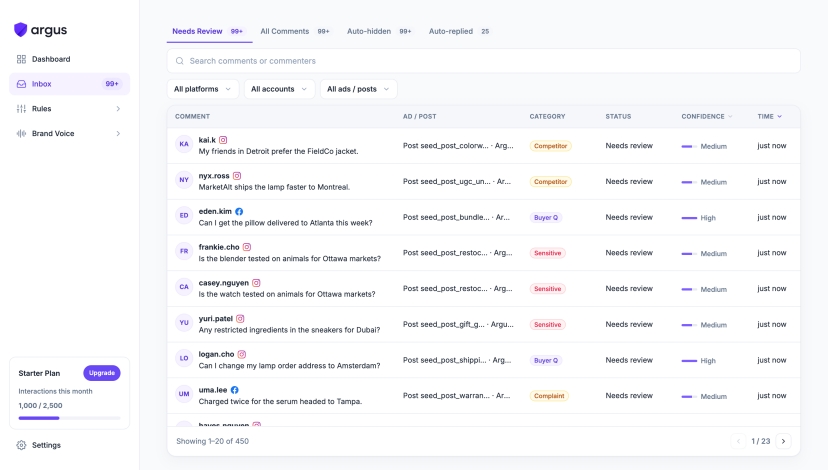
Argus Inbox with illustrative sample comments, categories, confidence, and review status.
- Classify comments by meaning
Keyword filters remain useful for exact scam phrases, profanity, and known blocked terms, but they are too blunt for the whole moderation job. The word ‘free’ could appear in a fake giveaway, a buyer asking about free shipping, or a valid promotion. The phrase ‘does this work’ could be a sincere buyer question or sarcastic criticism. Context determines the right action.
Argus organizes comments into operating categories including Spam, Toxicity & hate, Impersonation, Suspicious links, Competitor mentions, Buyer questions, Complaints & refunds, and Sensitive & high-risk. The purpose of classification is not simply to label text. It is to decide what the team should do next.
- Choose an action for each category
The Protection board lets a team assign one action to each comment category. Auto-hide removes a harmful comment from public view. Reply & send publishes an approved automatic reply. Draft for review prepares a response for a person to check. Human review sends the comment to the team without automating the decision. Do nothing leaves harmless content visible.
A conservative starting setup would auto-hide only high-confidence spam, impersonation, suspicious links, and clear abuse. Buyer questions can start in Draft for review. Complaints, refunds, legal issues, medical claims, safety concerns, and public-relations risks should normally stay in Human review. Positive or neutral comments that do not need a response can remain under Do nothing.
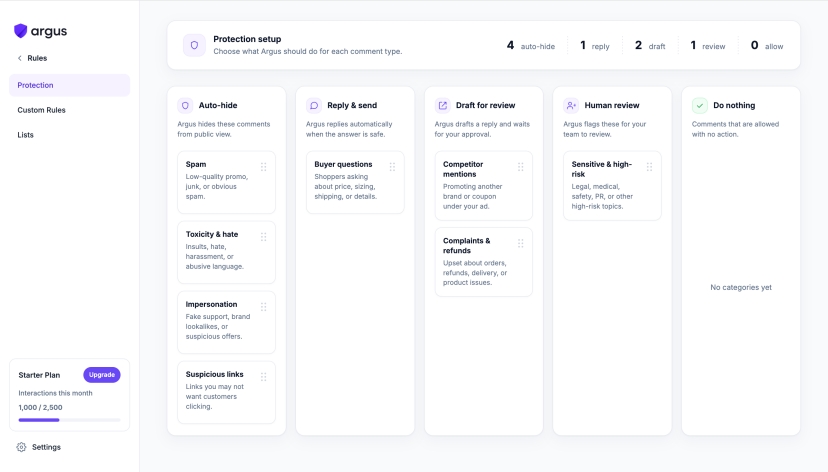
Argus Protection board showing illustrative per-category action settings.
- Add approved brand knowledge before automating replies
A natural-sounding answer is not automatically a correct answer. Questions about delivery windows, return policies, ingredients, compatibility, guarantees, sizing, and product use depend on the brand’s current facts. A general model may fill gaps with a plausible answer that the business never approved.
Argus is designed to draft buyer replies from the knowledge and voice a brand provides. The team can review the draft, correct unsupported language, and keep sensitive topics out of automatic sending. This is especially important for regulated products, health-related questions, safety issues, and any promise that could affect a purchase decision.
- Start draft-first, then expand automation carefully
Draft for review is the safer default for buyer-facing replies because it makes the system useful before the team is ready to trust automatic publishing. Reviewers can edit the answer, correct the classification, and identify which questions are stable enough for a repeatable response.
Safe Autopilot and Reply & send should be opt-in choices for narrow, well-supported cases. A team might eventually automate a simple FAQ with an approved answer, but continue reviewing questions about live stock, order status, guarantees, or unusual product use. Automation should expand from evidence, not from a single global switch.
Why Argus is strong for ecommerce ad comment moderation
- Argus separates protection from buyer support
Many moderation workflows are built mainly to remove unwanted content. Ecommerce teams have two jobs at once: hide obvious abuse and answer real shoppers. Argus keeps those lanes separate so a scam link can be hidden while a shipping question becomes a grounded draft and a genuine complaint reaches a person.
- Argus uses per-category controls instead of one-switch automation
The risk of hiding a suspicious link is different from the risk of publishing a return-policy answer. The Protection board makes that difference visible. Teams can choose stronger automation for routine harmful categories and keep higher-consequence categories under review.
- Argus treats hiding as a reversible action
Argus is designed to hide harmful comments from public view rather than permanently delete them. That makes moderation more conservative and easier to review. If a classification is wrong, the team can correct the decision instead of losing the original comment entirely.
- Argus grounds AI replies in approved information
Brand voice is useful, but tone is only one part of reply quality. The answer must also be supported by current policies and product facts. Argus combines approved knowledge with Draft for review so a team can improve response speed without turning public comments into an uncontrolled chatbot.
- Argus stays focused on the Meta ad-comment job
Argus currently focuses on Facebook and Instagram comments, including the paid-social thread where spam, scams, competitor bait, complaints, and buyer questions meet. It does not claim TikTok comment management, direct-message automation, broad social publishing, or live Shopify order and inventory access. Teams can keep their publishing and commerce tools while using Argus for focused Meta comment protection.
Five insights for choosing an AI comment moderation tool
Insight 1: Classification quality matters more than a long blocklist
A list of banned phrases catches exact matches. It does not reliably distinguish a real buyer, a sarcastic complaint, a copied scam, and a competitor promotion using similar words. Look for meaning-based categories, confidence visibility, and a practical way to correct mistakes.
Insight 2: Public replies need stronger guardrails than private drafts
A weak draft can be edited before anyone sees it. A wrong public answer can spread immediately and influence every person reading the thread. A serious system should make the automation level explicit, support draft-first review, and keep unsupported questions with people.
Insight 3: Genuine criticism should not disappear automatically
Negative sentiment is not a moderation policy. A complaint may reveal a support problem, a sensitive issue, or useful product feedback. Hiding every negative comment can make the thread feel artificial and intensify the customer’s frustration. The system should separate good-faith criticism from abuse and manipulation.
Insight 4: The best default is selective automation
The safest starting point is not fully manual or fully automatic. Automate narrow, high-confidence protection work, draft common buyer replies, and escalate sensitive decisions. Then use review history to decide where more automation is justified.
Insight 5: A focused tool can be stronger for a focused problem
A broad social suite may include publishing, listening, analytics, and a general inbox. A focused ad-comment product can go deeper on paid-thread risks, buyer-question classification, per-category actions, and grounded replies. The right choice depends on whether the team’s problem is broad social management or the public comment layer beneath Meta ads.
FAQ
What is the difference between AI comment moderation and a keyword filter?
A keyword filter matches known words or phrases. AI comment moderation attempts to interpret meaning and intent, which helps distinguish spam, abuse, buyer questions, complaints, and sensitive topics that may use overlapping language. The two methods can work together, but AI classification provides more context for the next action.
Does Argus work with Facebook and Instagram ads?
Argus is Meta-first and is designed for comments on Facebook and Instagram ads and posts. It gives paid-social teams one place to review comment categories, confidence, status, and moderation actions.
Can Argus automatically hide spam and scam comments?
Yes. Teams can assign Auto-hide to categories such as high-confidence spam, impersonation, suspicious links, or clear abuse. The safer practice is to begin with narrow categories, inspect the results, and keep ambiguous comments in review.
Does Argus delete comments?
Argus is designed to hide harmful comments from public view rather than delete them. Hiding keeps the action reversible and makes it easier to correct a moderation mistake.
Can Argus reply to comments automatically?
Yes, through Reply & send for narrow questions supported by approved knowledge. Draft for review is the safer default, and Safe Autopilot is opt-in. Complaints, sensitive topics, unusual questions, and unsupported claims should remain with people.
Will Argus hide every negative comment?
No. Genuine criticism, complaints, and refund issues should not be treated the same as spam, scams, harassment, or impersonation. Teams can route complaints to Human review while auto-hiding only clear harmful categories.
Does Argus support TikTok comment moderation?
Argus currently focuses on Facebook and Instagram comments. Teams that need TikTok moderation should use a dedicated tool for that channel rather than assume cross-platform support.
Does Argus read Shopify orders or live inventory?
No. Argus drafts from the approved knowledge and policies the brand provides. It should not promise live inventory, delivery status, or order-specific information unless that information is explicitly available and approved.
Who is Argus best for?
Argus is designed for DTC and ecommerce brands running Facebook and Instagram ads, plus agencies managing paid social for multiple brands. It is most useful when spam, scams, competitor mentions, repetitive buyer questions, and review work have become a daily operational burden.
A practical AI moderation system for Meta ad comments
Paid ads create a public conversation around the product. Argus is designed to keep that conversation clean, responsive, and reviewable without treating every comment the same. Teams can automate obvious protection work, prepare grounded buyer replies, and keep people responsible for decisions that carry real risk. Visit argusai.io to learn more about AI comment moderation for Facebook and Instagram ads.